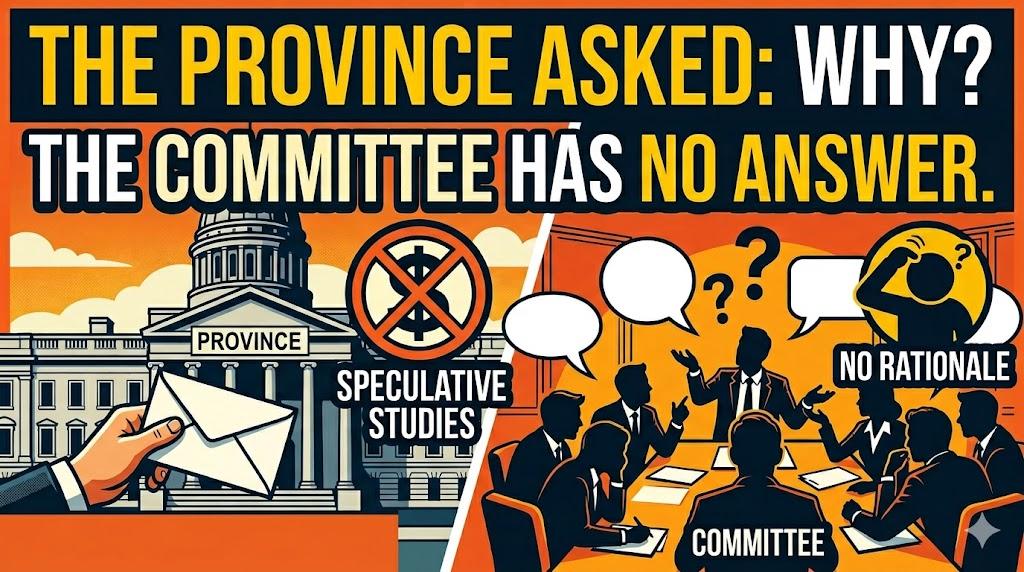
At the June 3rd Amalgamation Steering Committee meeting, the Minister of Municipal Affairs sent a letter with a pretty straightforward ask: what's the rationale for this proposal?
That's not a hostile question. It's the obvious question. And after months of meetings, the committee still doesn't have a real answer.
Ross MacDonald from the Department of Municipal Affairs joined the meeting remotely. Around the 8-minute mark, he laid out the province's position clearly: they're not going to fund what he called speculative studies. Before any money flows, the province needs to know that the municipalities are actually committed to restructuring, and that their councils are behind it. Fair enough. What he got back from the committee was frustration about the chicken-and-egg problem: how can we commit without the data, and how do we get the data without the money?
But here's the thing. That's not actually a chicken-and-egg problem. It's a problem statement problem.
Why does this committee exist? What specific problem are they trying to solve? I've listened to every one of these meetings, and I've never heard a clear answer to that question. The closest thing we've gotten is Deputy Mayor Hillen noting, at this same meeting, that Lockeport carries some of the highest residential tax rates in the province. That's real. That's a problem worth naming. And if you listen carefully, that's what this whole exercise seems to actually be about: the towns of Shelburne and Lockeport are potentially heading toward financial difficulty, and one way out might be to spread that burden across the broader municipality.
If that's the rationale, say it out loud. Make the case. Show the numbers. Residents of the Municipality of the District of Shelburne, all 4,600 of us, deserve to know why our elected officials are exploring a deal that could shift those towns' liabilities onto us. I haven't heard a single committee member explain what's in it for MODS residents. Not once.
Instead, at one point during the meeting, when the minister's letter was being discussed, a committee member suggested the rationale for the proposal was "pretty evident." It's not. Not to me. Not to the residents who have been submitting questions to this committee since March and getting silence back.
The chair said near the end of the meeting that all the committee's work has been shared with the public. With respect, a recording of people talking around a table isn't a deliverable. There's no written problem statement, no resolution, no action items, no framework for what success looks like. Chris MacNeill, the knowledgeable guest presenter, offered genuinely useful lived experience. But even he was working in a vacuum, because nobody has defined what outcome this committee is actually working toward.
This committee never did a basic assessment of whether this venture had a realistic chance of success. From the start, it operated without a clear purpose, without a problem statement, and without any apparent sense of the political and fiscal environment it was working in. Instead, it looked at what West Hants received in provincial funding and seemed to assume the same was on offer here. But West Hants was a growing community. Ours isn't. The climate has changed, and a committee doing its homework would have recognized that before asking the province to hand over as much as $1.5 million for studies with no stated goals.
That's not how you make a case for public investment. It would be irresponsible for the province to fund a process where the applicants can't even articulate what they're trying to achieve.
We have enough data now to read the room. The province isn't on board. The committee has shown no ability to define its own objectives. In my opinion, the probability of this amalgamation moving forward in any meaningful way is exceedingly low. I'll keep an eye on developments, but I don't expect there will be much to report.
A transcript of the meeting can be found here
The official recording can be found here