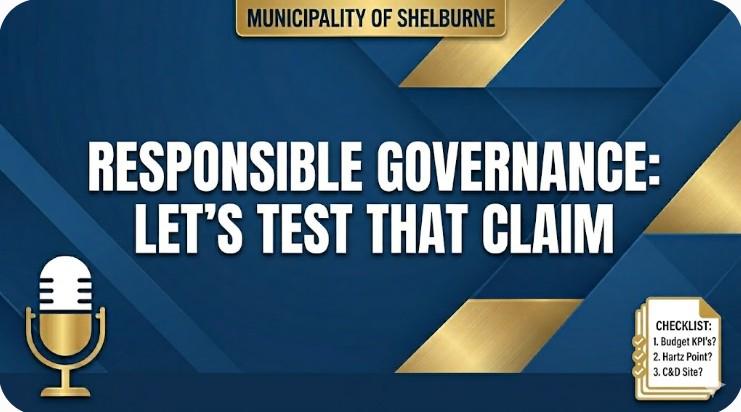
The Municipality of the District of Shelburne's summer/fall 2026 newsletter closes with a commitment to "enhancing responsible governance." It's a nice phrase. But responsible governance and transparency aren't two separate things. They go hand in hand. You can't genuinely claim one while actively undermining the other.
So let's take that claim seriously. Let's actually test it against what's happened here in the Municipality of the District of Shelburne.
The Budget
The budget process consumed multiple days and many hours of meeting time. And what did it start with? Roughly two hundred budget items in no particular order. No prioritization. No framework. Just a pile.
Turnout at the public consultation was exceedingly low. And there was a promise made that budget items would be traceable back to public input. As far as anyone can tell, that promise was never delivered on.
Then there's the KPI problem. Davis Pier Consulting, the municipality's own consultant, explicitly recommended that key performance indicators be built into the budget. Metrics first, then projects. That's basic professional planning. Instead, council was told that KPIs would be developed after projects were already underway. That's not planning. That's measuring after the fact and hoping the numbers look good. You don't define success after you've already started. That's the entire point of having metrics in the first place.
Then there's the wind turbine. A project that ran for eight to ten years was finally decommissioned. You'd think this would be the moment for some genuine reflection. Did the project achieve its goals? What went right? What went wrong? What did we learn? None of that happened. There was no analysis. No accountability. Just... done.
That's not responsible governance. That's winging it and hoping nobody notices
Hartz Point
Hartz Point is, honestly, a masterclass in how not to manage a public asset.
The story kept changing. First, there was no plan and no cost-benefit analysis. Then it became about stopping a wealthy developer from building a mansion. Then it shifted to attracting a luxury hotel. And now we're hearing about the possibility of DND building a wharf, while simultaneously being prepared for sale.
The municipality borrowed $1.4 million for this property. One point four million dollars. With no plan. Members of the economic growth committee have openly acknowledged that developing this property will be extremely expensive. So we've spent a significant amount of public money, we have no clear direction, and costs are only going up.
This isn't a rough patch in an otherwise solid project. This is irresponsible governance, start to finish.
The Highway 103 Property
Same story, different property.
The municipality bought the Highway 103 property and then hired consultants to figure out what to do with it. That's backwards. You figure out what you want to do with something before you buy it. The dreams attached to this property have ranged from becoming the next Exit 12, to landing an anchor tenant like Costco or Walmart, to the curious rationalization that it sits halfway between Yarmouth and Bridgewater. These might be reasonable starting points for a conversation. They are not a substitute for a plan.
Like Hartz Point, there was no cost-benefit analysis. No risk assessment. Just gut feel and a purchase.
This seems to be a pattern. Buy first. Think later. That's not responsible governance by any reasonable definition.
The C&D Site
The municipality attempted to close the construction and demolition site without any public consultation. The public pushed back hard. And then, suddenly, a solution appeared.
It's worth asking: why did it take public backlash to produce that solution? Why wasn't the public involved from the start?
Meanwhile, compare our service levels to Barrington. They collect garbage every week. We do it every two weeks. Barrington isn't cutting their C&D services. We're providing less and attempting to provide even less than that. If you're going to claim responsible governance, you probably shouldn't be quietly cutting services while a neighboring municipality runs circles around you on basic delivery.
The MPS and LUB Documents
A significant amount of public input went into the Municipal Planning Strategy and Land Use Bylaw documents. Most of it was ignored.
At the council meeting where these documents were passed, it was abundantly clear that councillors hadn't read them. The documents were adopted anyway. And then, after being officially passed, staff went back and changed the wording in certain sections. After the fact. After the vote.
Changing the wording of an official document after it's been voted on isn't a clerical detail. It's a serious breach of the public trust.
Public Consultation: A Pattern of Going Through the Motions
Every public consultation this municipality has held since the MPS and LUB process has had dismal attendance. And it's not hard to see why. They're poorly advertised.
When community members asked, in writing, twenty specific questions about how a consultation would be conducted, the municipality answered all twenty. That sounds good. Except then they didn't follow their own answers. They gave the appearance of accountability and then ignored it.
That's not consultation. That's performance. That's not good governance.
Transparency
Responsible governance and transparency aren't optional extras. They're the same thing. You can't have one without the other. A council that operates in the open, where residents can see how decisions are made and why, is a council that can be held accountable. A council that operates in the shadows can't be. It's that simple.
So how does MODS measure up on transparency?
Start with how the municipality defines a Council meeting. According to their definition, a gathering only qualifies as a meeting if all five of these conditions are met: a quorum is present, municipal business is discussed, the discussion substantially advances a matter toward a decision, formal procedures are followed, and voting or consensus testing occurs.
That's a very high bar. And it's not the bar the law sets.
Section 22 of Nova Scotia's Municipal Government Act is clear: all meetings are open to the public. The exceptions are narrow and specific. The default is openness, not secrecy. The MGA doesn't ask whether a discussion "substantially advances a matter toward a decision." It just says if council is meeting, the public gets to watch.
When a municipality creates its own five-part test, it opens the door to gatherings that look like meetings, feel like meetings, and do the work of meetings — without ever being called one. No public notice. No minutes. No accountability. That's not a technicality. That's the public being deliberately kept out of decisions that affect their community.
A municipality that genuinely valued transparency wouldn't need a five-part test to decide when the public is allowed in. It would just follow the law.
Summary
So. "Enhancing responsible governance."
The budget process had no structure and broke promises to the public. Hartz Point burned $1.4 million with no plan. The Highway 103 property was purchased before anyone figured out what it was for. The C&D site was nearly cut without a word to residents. Planning documents were changed after the vote. And public consultations are designed to look like engagement without actually being engagement.
And then there's the meeting definition. MODS uses its own five-part test for what counts as a Council meeting, a definition that bears no resemblance to Section 22 of the Municipal Government Act, which simply says meetings are open to the public. Their definition exists to exclude. The MGA's intent is to include.
Responsible governance isn't a tagline. It's a practice. It's transparency. It's following the law. It's making decisions with public input and being accountable for the results.