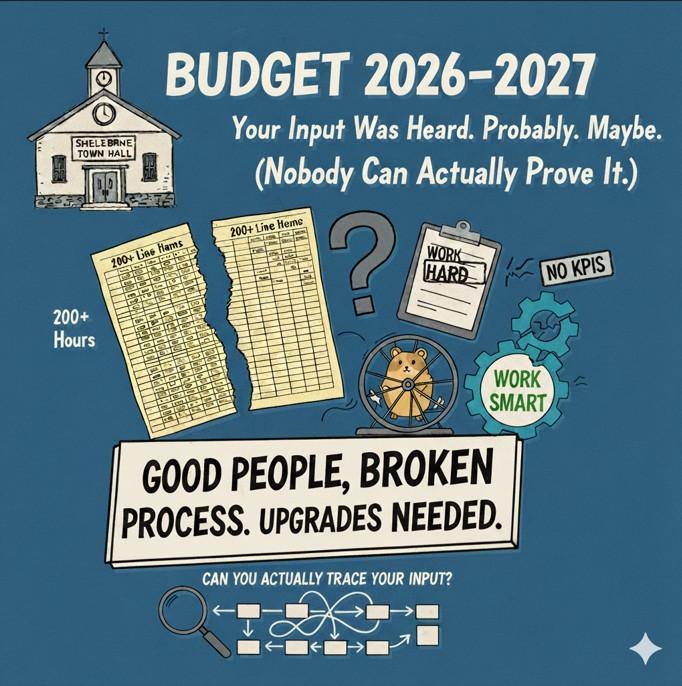
Good People, Broken Process. Shelburne's Budget Deserves an Upgrade.
Every year, the District of Shelburne goes through a multi-month budget cycle. Hundreds of hours from staff, long nights for councillors, and a handful of residents willing to show up and sit through it all. The effort is genuine on all sides.
And yet, a lot of people who followed this year's process closely walked away with the same nagging feeling: all that work, and we still don't really know what we're prioritizing or why. That's not a knock on anyone personally. It's a question about how the process is set up.
There's a Better Way to Run a Big Project
Complex work goes through five phases: Initiation, Planning, Execution, Monitoring and Control, and Closure. Every serious project benefits from this structure. It's not theory. It's just how organizations keep track of what they're doing and whether it worked.
So how does Shelburne's budget stack up?
Initiation is where you define what you're actually trying to accomplish. Shelburne held public consultations in fall 2025 to gather input for the Strategic Plan. The first two sessions had such low turnout the data wasn't really usable, and the process kept going anyway. After the final session, residents were told there had been "lots of valuable feedback." There's no written report to back that up. You can't verify what you can't read.
Planning is where you set the benchmarks that tell you if things are on track. KPIs, milestones, clear deliverables. At the February 2026 budget meeting, none of that was in place for any project on the list. When someone raised it, the answer was that KPIs would show up in future quarterly reports. The problem is, KPIs have to come before the work starts. You can't set guardrails after the car's already gone off the road.
Monitoring and Control depends entirely on the Planning phase being done right. Without benchmarks set upfront, there's nothing meaningful to measure against.
Closure is where you review what happened when a project wraps up. Did it hit its goals? What would you do differently? Of all five phases, this one gets the least attention, and it shows.
"That's Just How We Do It"
The February budget meeting ran eight hours. Over 200 line items got read aloud, one at a time, from a spreadsheet. No materials circulated beforehand. The Easter Egg Hunt and a major bridge repair got the same amount of discussion time. Councillors had a few minutes per item to make calls that sometimes involved hundreds of thousands of dollars.
Doing something the same way year after year doesn't make it work well. It just makes it feel normal.
A smarter approach isn't complicated. Give high-cost, high-risk items real time. Circulate materials in advance. Delegate routine spending to staff, who already have the authority to handle it. Use the time you free up to dig into decisions that actually shape where this municipality is headed.
Can You Actually Trace Your Input?
The process was presented as one where public feedback could be traced to specific projects. Residents were told their voices would show up in what gets funded.
Testing that claim was harder than it should've been. The first item under Pillar 1 of the Strategic Plan, updating the Climate Action Plan, points to a likely budget match at $77,250. That item is flagged as "immutable," meaning public input can't change it. Other Strategic Plan priorities ran into similar dead ends when traced to actual budget lines.
Saying public feedback was incorporated isn't the same as being able to show where.
The Simple Test
After everything, you should be able to answer one question: what are the top three priorities in this budget? If most councillors and most residents who followed the process can't say with any confidence, the process isn't doing what it's supposed to do.
Bringing some basic project management discipline to a municipal budget isn't a big ask. It means deciding what success looks like before you start, checking in while the work is happening, and being honest about the results when it's done. For any organization that takes public accountability seriously, that's just the starting point.
Conclusion
Most organizations that handle public money figured out a long time ago that good intentions aren't enough on their own. You also need a system. Shelburne has the intentions. The system part is still a work in progress.